The Night Before A New Tommorrow
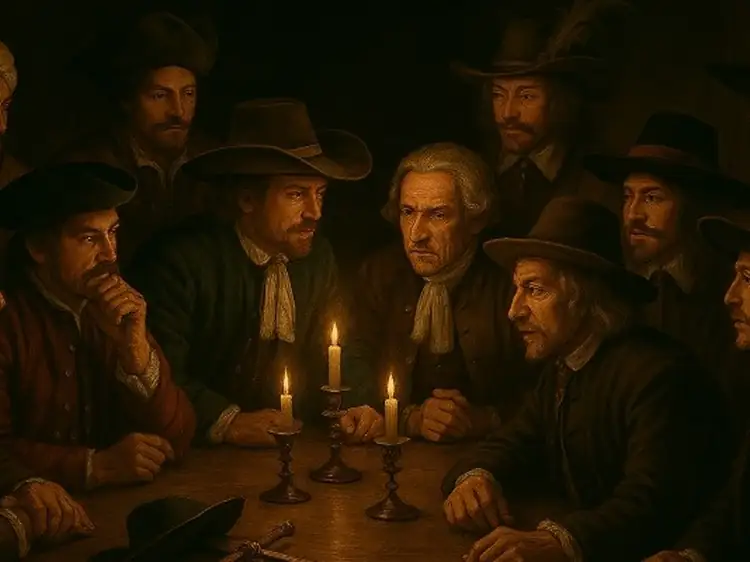
Centuries ago, before the modern age had codified the mechanisms of power, an exclusive society was forged with one overriding purpose: to maintain a world order that ensured western domination and stability. Born of the clandestine philosophies of an ancient Greek thinker - with whispers often attributing its foundation to the likes of Aristotle, Plato, or Pythagoras - this secret circle convened not to rule by decree but to steer history’s unfolding with subtle precision. Their guiding principle was simple yet formidable: to influence the great events of the world, channeling fortunes, wars, revolutions, and innovations in ways that cemented the enduring supremacy of Western civilization.
The Overlords – as they were known only to themselves - existed in the periphery, their actions never traced, their identities erased from public knowledge. Their influence stretched across continents - silently dictating wars, economies, revolutions, and scientific breakthroughs. It was they who orchestrated the rise and fall of empires. They had shaped the Renaissance, silently pulled strings behind the Industrial Revolution, and even chosen which governments would survive and which would crumble. Whatever the truth, the society endured through ages, its hands guiding the tides of history through manipulation, influence, and control.
Yet now, the balance they had so meticulously engineered was under threat. An emergency had been declared - a sign that the intricate machinery of global influence was faltering under contemporary challenges. In response, a secret summons radiated through their networks, calling them to an urgent meeting in a hidden chamber beneath an ancient cathedral in England. This was no ordinary gathering; it was a convocation meant to reassert control, recalibrate strategies, and ensure that the world order they had tirelessly safeguarded would continue unchallenged.
One by one, the chosen twelve emerged from the far-flung corners of the Western world. Their journeys, accomplished under assumed identities and through labyrinthine routes, testified to decades—if not centuries—of refined skills in secrecy and strategy.
Each man’s arrival was emblematic of his unique trade and legacy, contributing a vital strand to the web of influence they collectively wove:
Lord Montague Ashford (Britain) A towering figure in global finance, Montague had quietly built a web of banking institutions whose influence rippled across continents. He navigated the secret underpaths of London’s financial district, slipping into the night with a silent resolve to uphold the established order.
Jean-Baptiste Moreau (France) Renowned as a master of maritime commerce, Moreau’s empire of shipbuilding and trade carried the echoes of French maritime lore. His discreet arrival aboard a nondescript steamship allowed him to merge into the bustling harbor life, his presence a reminder of centuries-old ambition.
Theodore Van Dyke (Netherlands) An authority on maritime law and colonial strategy, Theodore epitomized the calculated expansion and order that had defined European trade for ages. Emerging from a historic trading house, his measured pace through the fog-laden streets of London reflected a lifetime dedicated to preserving the intricate rules of expansion.
Alistair O’Connell (Ireland) A master of subterfuge and espionage, Alistair was both shadow and whisper in the corridors of power. Disguised as an unremarkable traveler, he blended seamlessly into the crowd, his keen eyes ever alert to the undercurrents of global strategy.
Giovanni Ricci (Italy) A magnate in luxury goods and textiles, Giovanni’s influence reached deep into the cultural veins of Western society. Amidst aristocratic gatherings in Italy’s storied cities, he honed skills that allowed him to navigate social hierarchies with elegance—skills that now guided his discreet entry into England.
Frederick Braun (Germany) A visionary of industrial innovation, Frederick’s contributions to manufacturing and engineering had redefined modern production. Departing from an unassuming train carriage, his quiet presence belied the robust network of industry he had engineered across Europe.
Alejandro Velasco (Spain) A merchant with command over trade routes that resonated with the legacy of Spain’s imperial past, Alejandro arrived via hidden passages beneath abandoned docks. His journey was as much an act of stealth as it was a stroll down the well-worn paths of trade and conquest.
Vladimir Petrovich (Russia) A polymath whose scientific breakthroughs sparked both wonder and calculated controversy, Vladimir’s work bridged the realms of innovation and controlled advancement. Accompanied by a select military escort, he maneuvered through covert channels, ensuring that his genius remained a tool for sustaining the established order.
William Carter (United States) As a formidable curator of modern narratives, William wielded the power of media to shape public perception and reinforce Western ideals. His entrance was discreet—a silent ripple among London’s influential elite—yet his methods had transformed storytelling into a subtle battlefield for ideological control.
Samuel Abbot (Portugal) A cunning dealer in spices and rare commodities, Samuel’s trade routes were the hidden lifeblood of historical economies. Camouflaged within the mundane logistics of global commerce, he traversed borders with a quiet mastery that ensured vital goods—and influence—continued to flow unhindered.
Erik Johansson (Sweden) An ingenious engineer and shipwright whose blueprints sparked modern transportation revolutions, Erik’s innovations were as understated as they were transformative. His subtle arrival, blending into the common crowd, masked the enduring impact of his contributions to Western development.
Emile Beaumont (Belgium) A discreet maestro of precious metals and gemstones, Emile had cultivated a command over wealth that underpinned mighty empires. Disembarking in the quiet hours, his presence was as unassuming as it was meticulously calculated—a reminder of the enduring persistence of Western hegemony.
---
Before any grave matters were broached and as usually customary, the atmosphere was lightened by warm pleasantries as each member recounted tidings from his homeland.
Lord Montague Ashford, adjusting his cufflinks with a wry smile, “Gentlemen, I must say—London is abuzz with the new railway routes and stirring debates in Parliament over banking reforms. It seems progress is marching at a relentless pace, though not without its disruptions. Tell me, does anyone else sense that even our mundane affairs hint at deeper shifts in the times?”
Jean‑Baptiste responded with a reflective nod “Indeed, Montague. From Paris, I hear that while the cafés still brim with spirited discussions, there’s also an undercurrent of unease. The postal system’s delays and persistent bureaucracy are causing more than a bit of frustration among the merchants. Change is in the air, whether we welcome it or not.”
Theodore Van Dyke quietly interjecting “Amsterdam speaks in kind—the canals remain calm, yet our trading houses are abuzz with talk of possible constitutional tweaks to merge tradition with progress. Every ripple in commerce seems a harbinger of transformation.”
Alistair O’Connell spoke with his Irish lilt softening the formal tones “And back home, the countryside battles harsher seasons and economic slowdowns. The rustic lanes whisper of impending strife amidst seemingly trivial market mishaps. It’s as if the ordinary itself is a precursor to something extraordinary.”
Giovanni Ricci chuckled warmly “Milan’s artisanal quarters and Venice’s salons, filled with lively repartee, are abuzz with cautious speculation over new political ideas. Even our daily exchanges hint at a future reshaped by forces beyond mere chance.”
Frederick Braun in a crisp, measured tone “In Prussia, every hammer’s strike in the factories heralds not only industrial progress but also a growing restlessness among the masses. It appears that the engines of modernity might be heating up both production and protest.”
Alejandro Velasco with urgency from the Spanish mainland “Madrid tells a similar tale. Merchant ships whisper of extended hours in the docks and tighter oversight—a sign that even our established routines are struggling to keep pace with change.”
Vladimir Petrovich thoughtfully, his voice low “St. Petersburg and Moscow remain paradoxical. Intellectual salons brim with covert publications that defy censorship, suggesting that while tradition endures, restless winds of innovation are stirring quietly.”
William Carter with an insightful gaze “From the Eastern seaboard, I gather that the murmurs about a distant gold rush in California are beginning to reshape commerce. Modern narratives here channel both promise and peril, much like our own carefully plotted schemes.”
Samuel Abbot softly, with a knowing sigh “In Lisbon, the docks remain busy yet are marred by small-scale disruptions—minor delays here and there that hint at larger systemic pressures. Even routine trade now carries an undercurrent of uncertainty.”
Erik Johansson was calm and reflective “Stockholm, however, maintains its dignified pace. Yet even here, among the learned, a quiet debate about progress and tradition persists, exposing an undercurrent of doubt in our established order.”
Emile Beaumont concluding the catch-up on a measured note “Brussels finds its delicate balance between art and industry disrupted by minor market renovations and shifts in merchant confidence. It seems that even the most enduring structures feel the weight of time.”
---
As the conversation tapered off, a measured silence fell. The focus soon shifted from the daily vignettes of national affairs to a more urgent topic scribbled in secret dispatches from Africa.
Lord Montague steered the conversation with a deliberate question “Gentlemen, our latest dispatches have turned our attention to the African coasts. Tell me—have you observed that the indigenous communities, once content with our mirrors and gin, are now demanding something far more potent?”
“Indeed, Montague.” Alistair said “The word from my contacts in America is unmistakable: they now yearn for firearms. What once was a market for trinkets has transformed into a demand for power—an escalation that fuels conflict among tribes.”
“Firearms, you say? Do we have any solid reports on how widespread this appetite is? I mean, is it just a few isolated cases or a genuine shift in the trade dynamic?”
“My lines report that this demand is far from isolated. Once a weapon is introduced, skirmishes erupt, and our scheduled shipments are delayed amidst the ensuing chaos. Every conflict costs us time and profit.” Braun remarked.
Giovanni with a wry smile tinged with concern “It is indeed ironic. Our once-reliable gifts have lost their allure, replaced by a bitter hunger for arms. These constant conflicts—and the perilous waters that compound the delays—are making our expeditions increasingly expensive.”
“Are we perhaps inadvertently fueling this cycle? Our established tokens, once seen as benign gestures, might now be viewed as insufficient. If our offerings provoke an insatiable thirst for weaponry, how can we hope to restore order?”
“The economic calculus is becoming unfavorable. With the sea routes now fraught with danger, each lost shipment translates to steeper costs. Our risk factors are rising alarmingly.”
“Madrid’s ledgers are grim—our expenditures have doubled in these uncertain times. We are at a crossroads where traditional methods no longer suffice. What are our options?”
“Could it be that our established paradigm is at its end? If our methods trigger uncontrollable conflict, might the winds of moral and political change from the West be too strong to ignore?”
“If our methods are triggering unintended consequences, shouldn’t we be considering a complete overhaul? What alternative strategies could we employ to stabilize these volatile exchanges?”
“Maybe we need to rethink our very commodity mix. Could we introduce an alternative product—something that appeals to their desire for power without igniting further conflict? Or even better, might we re-calibrate our terms to dissuade this rampant demand for firearms?”
“Our operations are hemorrhaging costs with every lost shipment. The current approach is unsustainable. But then—what can we realistically offer that would neither escalate tensions further nor compromise our influence?”
“Whatever the solution, time is not on our side. We stand at a precipice where inaction could unravel the stable network we’ve always maintained.”
“Even worse, the moral forces are already whispering for change in the West and are poised to seize this crisis. The momentum of reform might then be thrust upon us, leaving our strategies in disarray. Is there a way to redirect this course—to wind down our involvement on our own terms rather than see it unravel chaotically?”
---
A heavy pause followed as all eyes turned toward Alistair, whose reputation for bold suggestions was well known.
“Perhaps it is time for us to be the masters of our own fate. Instead of allowing the organic challenges to force our hand, why not initiate the controlled winding down of the trade? If the Western world is already turning its back on these practices, wouldn’t it be wiser to determine the pace and direction of its decline—with us firmly at the helm?”
A ripple of surprise swept the room, quickly transforming into a series of probing questions and affirmations.
“Are you suggesting that we orchestrate the decline, to preempt the rising abolitionist fervor in the West?
“Indeed, if we manage the process, we retain our influence. What will happen if Africa develops on its own? The wealth locked in its soil is immense, and its newfound autonomy would weaken our influence over Western wealth and authority. Our advantage could evaporate. We can’t grant complete independence to Africa and risk the continent’s wealth being liberated entirely from our control”
“What you suggest has merit. By dictating the terms of decline, we can prevent a total rupture. We safeguard not only our profits but our long-held dominance over these critical routes.”
“Agreed, if left to organic development, the continent’s bounty might empower new elites to challenge our hegemony. It is wiser, then, to steer this process, ensuring Africa remains, in substance if not in form, tethered to our influence.”
“The entire structure of Western authority must not be allowed to weaken. How do we proceed”
“As a first strategy, we would create countries of disingenuous communities so they there would be uncontrollable and incessant conflicts”
“Precisely. Conflicts would need arms ensuring perpetual dependency. And what of their leadership? If we nurture an environment where corruption is the norm—where our banks serve as the safe haven for misappropriated funds—we bind them even tighter. Their rulers become complicit in their own stagnation and that authentic development is perpetually sidelined.”
“Then consider the final twist: deprived of genuine progress, the very people of Africa will eventually be driven to seek salvation elsewhere. They will embark on dangerous journeys to the West in search of better lives. It will echo the old practices of slavery, only now, the so‑called slaves will come by their own desperate choice.”
“So, to be clear—we do not merely end the trade; we redefine the entire relationship. By dictating the terms of its decline, we secure a future where Africa remains fractured, its potential for unity never realized, and its people continuously tethered to our influence.”
“Exactly. Through every calculated measure—a controlled wind‑down, perpetual dependency, and engineered discord—we preserve not only our profit but also the delicate balance of power that has long ensured our dominance.”
“Then our objective becomes twofold: we wind down our illicit trades in a systematic, controlled fashion, and simultaneously engineer a state of permanent dependency. In this duality lies our power.”
“By managing this transformation, we ensure that even as we relinquish the old practices, our influence remains unchallenged. The continent, fractured and ever reliant on our mechanisms, continues to serve our long-term interests.”
---
Finally, Lord Montague Ashford noting the harmony of purpose surveyed the assembly with measured gravitas. “It is settled then. We will steer the decline on our own terms, ensuring that the recession of our operations becomes a strategic reformation—a way to preserve both our legacy and our future influence over Africa and the global order. Let us then refine this strategy and prepare to implement it immediately—so that when the winds of change blow, we alone determine their course.”
In that dim chamber, as the candles danced and shadows merged with intent, the overlords embraced a plan that promised to convert impending change into a mechanism for continued, hidden dominion.
With a few hours of deliberations by a dozen men, Africa would remain doomed for at least another two hundred years.