The Case for the King of the Beasts
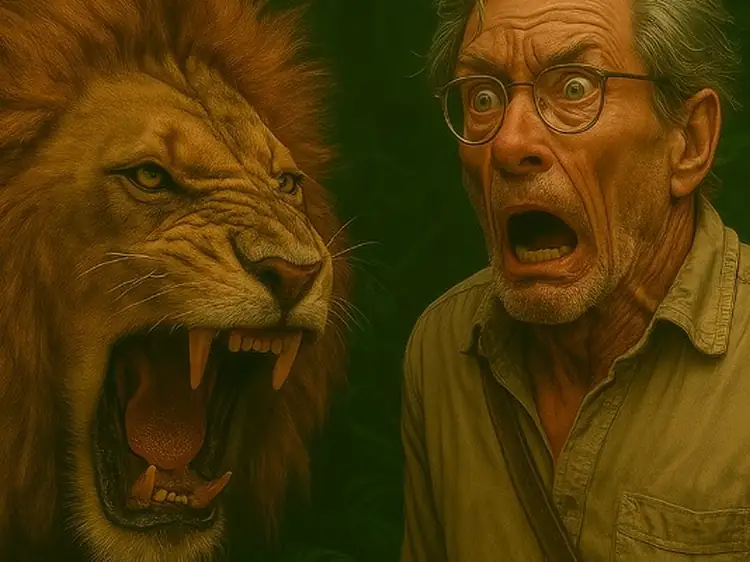
The Amazon stretched infinitely in every direction, a tangled masterpiece of vines, towering trees, and the restless chatter of unseen creatures. The air was thick with the scent of damp earth, decayed leaves, and the musky breath of distant predators. Beneath a dense canopy of vines, towering trees, and murmurs of unseen life, the balance of life had shifted—famine had struck, hunger and despair had woven themselves into the fabric of the jungle.
Among its inhabitants roamed a lone lion — once a proud member of a mighty pack, now separated by famine. His lean, tawny body bore the marks of starvation, yet his eyes still shone with the vestiges of regal power. His hunger burned like a fire in his belly, gnawing at his strength with every passing hour. He had chased rodents, snapped at fleeing monkeys, but none had filled the void inside him. He needed more. He needed something worthy of a lion’s hunt.
Through the labyrinth of trees, another figure struggled forward—a man, weary and lost. He was no hunter, no survivor hardened by the wild. He was a Professor of climate laws—a scholar, a man of books and theories. Days earlier, his research expedition had soared over this endless green, but the cruel hand of fate had ripped their helicopter from the sky. Now, he was alone, a stranger in a land indifferent to his intellect.
It was evening, and the light slanted through the treetops in golden shafts. Then, as if guided by some invisible force, their paths crossed.
Two creatures. One of intellect, the other of instinct.
The professor froze. The lion halted.
Their eyes met—man and beast locked in silent communion. The jungle itself seemed to hold its breath.
But hunger does not wait. A deep growl rippled from the lion’s throat, vibrating through the trees. Its muscles tensed, paws shifting forward. The decision was made — this man, fragile and unarmed, would be its meal.
The professor trembled. He had no weapon, no means of defense. He was prey. And yet, in the split second before the lion lunged, something happened.
The forest blurred into nothingness, and his mind expanded beyond flesh and thought — he was seeing into eternity. The heavens parted, pouring knowledge into him — knowledge as old as time itself. He saw the creation of the world, the forming of beasts, and the moment of divine decree:
"And God said, 'Let us make man in our image, after our likeness: and let them have dominion over the fish of the sea, and over the fowl of the air, and over the cattle, and over all the earth, and over every creeping thing that creepeth upon the earth.'"
The professor gasped, the words ringing through his very soul. This was no mere revelation— it was a communion of the truth.
Confidence surged through him. His trembling ceased.
Digging his feet into the earth, he raised his hands high — palms open, defiant, commanding. His voice erupted, deeper than he had ever known, carrying the weight of an ancient decree:
“Stop! I command you by the edict of creation to halt. For I was given dominion over you by God Himself! Stop and bow to me!”
The lion skidded to a halt, its golden eyes flaring wide. It had never known hesitation, had never known fear. And yet, something in the man’s voice — something beyond mortal authority —rooted it in place.
The command hung in the heavy air, and for a moment, the lion faltered. Its fierce, golden gaze wavered between raw instinct and bewildering contemplation. Then, something extraordinary happened: the tongue of the beast, once limited to roars and growls, began to form words—a language born of the wild, yet imbued with ancient wisdom.
With a deep rumble that resonated like the echo of ancient thunderstorms, the lion spoke:
“To what authority do you claim this dominion?”
He paused, surveying the professor with an unyielding intensity, then continued, his voice a blend of awe and challenge:
“Behold your mortal frame — frail and thin, lacking the imposing grandeur of the elephant, whose mighty bulk and resolute strength can move the very earth. Your limbs, fragile as they are, stand in stark contrast to the robust legs of the rhinoceros, armored in nature’s own plate, charging with an indomitable force.
Observe your teeth — short and blunt, suited only for uttering idle words — whereas the swamp crocodile wields serrated fangs, each a blade refined by eons to rend flesh from bone with surgical precision. And these hands — raised to halt my advance — are but a pale mimicry of the tiger’s mighty paws, whose crushing grip can topple ancient trees as if they were mere twigs.”
The lion’s gaze swept upward, as if inviting the professor to answer from realms beyond his reach:
“You have no wings to soar the heavens like the regal eagle, whose feathers command the boundless skies. In the watery dominion, you possess no grace to carve through the depths as does the white shark, the silent sovereign of the ocean’s dark corridors. Your steps, slow and burdened, could never rival the cheetah—nature’s very embodiment of speed, a blur racing across the Savannah under the gaze of the sun. Nor can your legs muster the explosive power of the kangaroo; those legs, leaping with fierce energy, defy gravity with every bound.”
Lowering his formidable head, the lion’s eyes narrowed with a mix of incredulity and earnest inquiry:
“And what of the jaguar, agile and cunning, whose stealth is matched only by its lethal prowess? Or the wolf, whose bonds of unity and relentless spirit forge dominion over the untamed wild? How, then, do you — a being of frangible bone and fleeting breath — lay claim to a power so vast and elemental? What substance underpins this divine decree you invoke?”
For a heartbeat, the lush, ancient forest seemed to listen in silent expectancy, as though every creature — the mighty elephant, the armored rhinoceros, the relentless crocodile, the fearsome tiger, the soaring eagle, the graceful shark, the swift cheetah, and even the stealthy jaguar and resolute wolf — awaited the professor’s response. In that sacred moment, the challenge was laid bare, echoing the timeless question of nature: on what foundation is humankind’s dominion built?
Professor’s eyes blazed with the fire of revelation, his voice steady and resonant as he absorbed the lion’s challenge. With the calm assuredness of a man who had glimpsed the divine, he replied:
"Great beast, nature's might be undeniable. Yet, the strength I wield is not measured in muscle alone, but in the ingenuity of the human spirit. Consider the elephant — majestic and mighty in flesh — but behold our towering skyscrapers, monuments of iron and glass that stand resolute against the winds, assembling the dreams of millions into structures that dwarf a thousand elephants.
And look to the rhinoceros, armored and unyielding on its robust legs; still, man has forged excavators and bulldozers, engines of relentless power whose mechanical jaws carve through rock as if it were soft clay, reshaping landscapes with precision and force.
Your praise for the crocodile's lethal fangs is well spoken, yet our inventions — drills, serrated saws, and cannons — are tools honed to perfection, biting through stone and sinew alike with a precision that nature could only mimic at its slowest pace.
The tiger’s crushing paws may send tremors through the jungle, but remember: man’s machines, with hydraulic might and meticulously designed presses, can dismantle the very bedrock of the earth.
While the eagle soars on wings crafted by nature, mankind has soared even higher, piloting planes to the stratosphere — flying vessels that outstrip any feathered monarch in speed and grace, venturing into realms where the eagle’s cry is but a whisper in the void.
In the depths of the oceans, where the white shark swims with elegant terror, our mighty ships and agile submarines traverse the seas at speeds that leave the swiftest predators in their wake, exploring mysteries hidden far beneath the swirling tides.
The cheetah’s fleet-footed dash races through the Savannah with breathtaking velocity, yet our land vehicles — cars, trains, and rockets — carry us across continents, spanning vast distances in moments, their speeds rivaling even the wildest winds.
And the kangaroo’s bound, powerful and instinctive, pales in comparison with the audacity of rockets — machines that defy gravity itself, launching us into the heavens to touch the very stars.
I do not forget the cunning of the jaguar or the unwavering unity of the wolf. Through networks of communication and invention, humankind binds societies together, creating bonds and strategies that allow us to overcome nature’s solitary designs.
Thus, my claim to dominion is not born of mere physical might, but of an unparalleled ability to transcend nature's limitations — to harness the elements, to invent, and to shape the very fabric of our world with knowledge and will. This is the authority granted to us, not by our flesh, but by the boundless curiosity and courage that defines our kind."
His words echoed through the dense canopy, a counterpoint to the lion's primal list — each animal’s raw trait met with the indomitable creations of man. The forest, alive with the echoes of ancient lore and new ambitions, seemed to pause in anticipation of the lion’s reply.
The mighty lion, his fur rippling with confusion and the remnants of primal hunger, paused in the dappled twilight. His ancient eyes, trained by instinct alone, were now bewildered by words that carried the shimmer of a realm beyond raw might. Seizing this moment of uncertainty, Professor, emboldened by his divine epiphany, pressed his advantage further — his voice resonating with the confidence of a destiny fulfilled.
"Great beast," He continued, his voice not trembling with fear but rising with the cadence of centuries of collective human wisdom. "Our strength is not measured solely by force or instinct. We claim dominion because we have transcended the natural chaos through our capacity for reason, collaboration, and organization.
"While your existence is shaped by the raw immediacy of survival, humankind has built ordered societies where every challenge is met by the might of our minds. We have crafted communities governed not by the clash of tooth and claw, but by systems of law and reason. In our cities, towering structures and bustling streets bear testament to our collective will — cities meticulously planned and built by hands and minds united in purpose."
"Our societies are ruled by deliberation and mutual respect rather than the impulse of violence. We have forged institutions that settle disputes through dialogue and votes, where every voice has a place in the symphony of governance. These frameworks are our strength, a network of ideas and agreements that empower us to shape our destiny, innovate beyond natural constraints, and chart the course of civilization itself."
Somewhere in the words of the man, the beast found an opening to counter. He retorted as follows, “You claim dominion because your mind has built wonders, but from where I stand among the living pulse of the earth, your achievements are tainted by a darker legacy. For every marvelous contraption that lifts you beyond the clouds, there is a trail of devastation in its wake.
"You speak of order and boast of governance by reason and vote yet your history is written in blood. You call my kind savage for hunting to survive, but tell me — what do you call men who have slaughtered millions, not for hunger, but for power, greed, and cruelty?"
The lion’s breath was hot as he continued. "Shall I speak of Adolf Hitler, a monster worse than the vilest of snakes who led a war that consumed the world and orchestrated the deaths of millions? Or Joseph Stalin, whose foulness overwhelms the foulest of skunk and whose iron grip crushed his own people, sending countless souls to perish in frozen wastelands? And what of Mao Zedong, a scavenger more deceptive than the hyena whose ambitions starved and silenced tens of millions? Or King Leopold II, the bloodsucking leech who turned the Congo into a graveyard, his greed drowning a nation in suffering, and not forgetting Idi Amin, uglier than the ugliest of vultures in looks and at heart who literally ate his own people?"
The lion’s tail flicked, his muscles coiled with restrained fury. "You claim mastery of order, yet your kind has built empires upon bones. You mold laws to serve the strong while the weak suffer beneath your feet. Is that order? Or is it simply a cage built by the cleverest beast?"
The wind howled through the treetops, as if nature itself were listening. "The forest may be wild, but it is honest. We do not kill beyond our need. We do not betray. We do not wage wars that last generations. We live by the laws of nature, not the lies of rulers."
In your organized society, beneath the gleam of neon and concrete, birds no longer find solace in towering trees; their nests lie empty as ancient arboreal cathedrals are felled to make way for progress. Once, monkeys danced effortlessly among verdant branches—now, their world grows barren as the canopies vanish beneath the weight of roads and steel. And what of the fishes? The clear, vibrant waters in which they once swam have turned murky with toxins, a bitter inheritance of industries and neglect.
With your hands, you have forged inventions that once promised salvation and marvel, yet those same hands have wrought destruction on the delicate balance of the natural world. Every invention, every great machine built in the name of progress, has in many cases succeeded in peeling off another layer from the life of our collective abode. This is not dominion, but betrayal — betrayal of the sacred trust that was meant to guide you as stewards of creation.”
The lion’s tone was neither merely angry nor contemptuous; it carried the weight of millennia, of a natural order upset by the very hands meant to protect it. His words challenged the professor’s exalted proclamations, cutting through the veil of human pride to expose the true cost of a dominion that has all too often turned its back on nature.
For a long, heavy moment, silence reigned over the forest as the lion resumed its solemn discourse. Its eyes, deep with ancient sorrow and unyielding truth, fixed upon Professor Nathaniel. In a deep, resonant tone that mingled both lament and rebuke, the lion spoke:
"It is true that man has been granted an easier path by the gift of an advanced mind. In your world, forests give way to steel and concrete, and you weave your dreams in the safety of organized cities ruled by laws and votes. Yet you must know that while you enjoy crafted luxuries and the ease of reason, we animals live by the raw, brutal struggle of existence. We are forged in the crucible of necessity—predators and prey in a never-ending contest, where survival is dictated by the strength of our hands and the desperate instinct to live. All we know is the relentless fight born of fear, a daily contest that does not afford a second chance."
The professor's confident gaze began to falter as the lion’s words sank deep into his soul. With every syllable, the well-rehearsed justifications of human prowess seemed to diminish, leaving behind the harsh reality of the jungle—a life of fierce survival where every moment held the possibility of death. The professor’s keen mind, so adept at forging marvels, now felt the weight of his own fragility recalled in the soft murmur of the wind among the trees.
Continuing in a measured, accusatory cadence, the lion declared:
"Today, you stand before me not as the exalted master of creation, but as one lost in the wild — a being stripped of artifice and innovation, judged solely by the strength of your hands and the will to live."
As the lion’s words reverberated through the dense undergrowth, reality began to dismantle the illusions that had buoyed the professor’s once-unshakable confidence and mercilessly exposed his vulnerabilities to him. Images of his family—laughter, warm embraces, the gentle touch of those he dearly loved—flashed unbidden through his mind. In that fateful moment, the strength in his arms, once raised in defiant command, began to wane. With that shuddering consciousness and a sinking heart, his hands grew as heavy as steel and dropped unceremoniously to his sides, and the resolute light in his eyes was slowly extinguished by a tide of fear.
Sensing the shift, the lion’s primal instincts surged back as the heady aroma of fear and fading vestiges of pride reached its keen nostrils. The calm of philosophical debate shattered in an instant.
Thus, in the murky gloom of the Amazon, the ancient dialogue between man and beast reached its devastating climax. The lofty claims of human dominion, bolstered by divine revelations and grand inventions, clashed with the unyielding, eternal edict of the wild: that true authority is earned in the crucible of survival and respect for all life.
With the speed and raw power that only nature could command, the lion lunged forward—a blur of tawny muscle and instinct—punctuating the final verdict of the wild.