The Shades of A Constitutional Crises
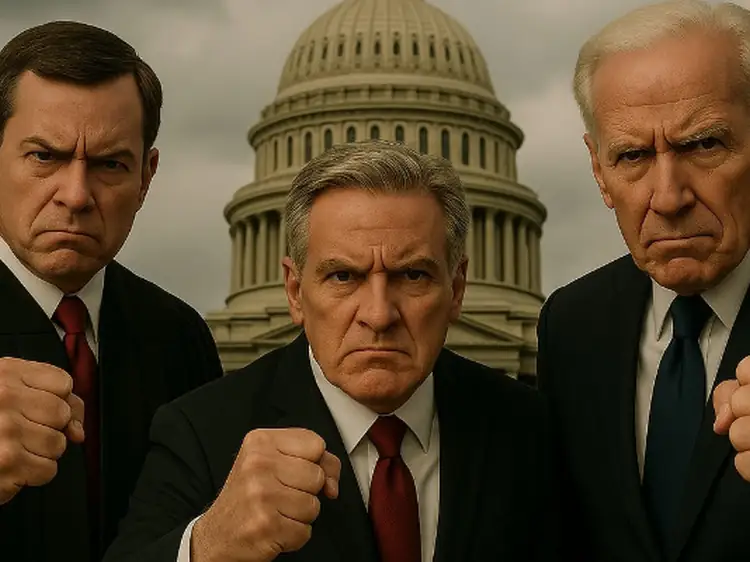
The Founding Fathers, brilliant minds with lofty ideals, gathered in sweltering halls, quills scratching against parchment as they forged the blueprint of a fledgling nation. They debated liberty, tyranny, representation, and power, weaving a document that would stand as the supreme law of the land. It was elegant, ambitious—and, as the years would prove, maddeningly interpretative.
As centuries passed, legal scholars pored over its words with reverence and frustration. What exactly did "necessary and proper" mean? How broad was "general welfare"? And what did the comma placement in the Second Amendment actually suggest? Judges wrestled, legislators squabbled, and presidents wielded executive authority like a prizefighter testing the limits of the ring.
With questions of separation of powers persistently unresolved, three figures—the President of the United States, the Speaker of the House, and the Chief Justice of the Supreme Court—made a historic decision. Rather than allowing ambiguity to fester and rhetoric to spiral into chaos, they agreed to take action in the most dignified manner possible: a three-day retreat.
Away from the distractions of reporters and lobbyists, they sought clarity amid the rolling hills of a secluded estate, where the Constitution's mysteries could be unraveled over quiet discussions, evening brandy, and, ideally, without any accidental declarations of war.
They had no illusions—power was a fickle force, and history was a cruel referee. But if anyone could finally sift through the legal fog, it would be these three. Or so they believed.
The estate chosen for their retreat was a sprawling colonial manor nestled in the countryside, far removed from the clamor of Washington, D.C. The air was crisp, the grounds immaculately kept, and the staff discreetly trained to ignore any accidental policy declarations over dinner.
---
One by one, the three most powerful men in the nation arrived, each embodying the distinct traits of their respective roles—both in governance and in personality.
First to step out of his armored vehicle was The President. He was a man built for optics—tall, broad-shouldered, and possessing the kind of jawline that had been sculpted by political destiny. His suit, tailored to perfection, barely concealed the fatigue of a leader carrying the weight of the country on his back. An accomplished individual with a penchant for dramatic speeches, he believed firmly in executive decisiveness—which, unfortunately, often translated to bypassing Congress in ways that left legal scholars hyperventilating.
He was accompanied by aides who whispered reminders about protocol, though he waved them off. “Three days to fix the country? Piece of cake.” His confidence was unwavering, even when it had no logical foundation.
A few minutes later arrived The Speaker a man who understood political survival as well as any seasoned legislator. He was of average height but carried himself like a man used to commanding attention. His salt-and-pepper hair, though perfectly combed, hinted at battles fought on the House floor—endless negotiations, filibusters, and backroom deals made over lukewarm coffee.
The Speaker was the kind of politician who could win a debate without ever taking a stance, a skill developed after years of navigating an increasingly chaotic Congress. He adjusted his glasses, surveyed the estate, and immediately wondered where the nearest bourbon was—a necessary fuel for enduring both constitutional arguments and Winslow’s unrelenting optimism.
Last to arrive, stepping out with an air of unshaken composure, was The Chief Justice—a man who embodied judicial austerity down to his core. His meticulously pressed suit, dignified posture, and piercing gaze gave the impression that he weighed every word before uttering it. And he did.
The Chief Justice, unlike his counterparts, did not indulge in political theater. He was a strict constitutionalist, the type who scoffed at legislative ambiguity and despised executive overreach. His career had been built on interpreting the law, not bending it, and he had little patience for politicians who believed otherwise.
As his polished shoes touched the gravel driveway, he sighed quietly. “This will be… interesting.”
The three men—each the embodiment of their branch—stood before the manor, sizing each other up. Three days, one grand estate, and centuries of constitutional confusion.
Would they resolve the crises? Or would history simply add their retreat to the long list of political spectacles?
---
The retreat’s grand library had been transformed into their war room—its towering bookshelves filled with volumes of legal theory, historic rulings, and more interpretations of the Constitution than any sane mind could endure. The heavy oak doors were shut, their entourages dismissed. It was just three men, one document, and centuries of unresolved ambiguity.
At the head of the long table sat The President, leaning forward with the intensity of a man preparing for battle. The Speaker, ever the skilled negotiator, sat back with an air of seasoned patience, his fingers lightly tapping against his coffee cup. The Chief Justice had positioned himself with the quiet confidence of a jurist who had spent a lifetime dissecting legal texts, prepared to deliver interpretations with surgical precision.
The discussion began smoothly, cordial, almost optimistic—the way these things often do.
The President spoke first: “Gentlemen, we all agree that the Constitution intends for balance among the branches. But let’s be frank—recent history has proven that executive authority has become… necessary.”
The Chief Justice wasn’t having that: (adjusting his glasses) “Necessary is a dangerous word, Mr. President. The framers did not intend for the executive branch to dictate the interpretation of necessity.”
The Speaker: (sipping his coffee) “We should clarify not just power but accountability. Congress must legislate without endless presidential vetoes and judicial entanglements.”
These words excited The President: (grinning) “Ah, so you admit the courts have meddled too much?”
The Chief Justice was ready with a defense: (icy tone) “We interpret. We do not meddle.”
For a while, the conversation remained measured. The men spoke of checks and balances, the limits of executive orders, and the judiciary’s role as the constitutional referee. Proposals were floated—greater specificity in legislative procedures, judicial term limits, and even an absurd suggestion about requiring all federal rulings to be written in plain English so citizens wouldn’t need lawyers to decode them.
As time ticked by, however, the discussion became less about theories and more about grievances.
The President bemoaned congressional gridlock. The Speaker lamented executive overreach. The Chief Justice defended judicial integrity, frustrated that presidents and legislators alike treated Supreme Court rulings as mere suggestions rather than definitive law.
The temperature in the room rose, voices sharpened, and subtle smirks turned into thinly veiled challenges. Each man was a guardian of his branch, and the centuries-old battle for power was playing out in real time, in this quiet, dignified retreat.
Somewhere outside, their aides waited anxiously. Would this be the moment clarity was finally achieved? Or would history simply record this retreat as yet another noble but doomed effort at unity?
The atmosphere in the secured chamber had shifted in a heartbeat. What had been an earnest, if strained, dialogue transformed into a battle of wills. With every pointed phrase, the tension thickened until a single misread gesture ignited a chain reaction that would descend the room into chaos.
It began when The President leaned forward—an emphatic motion meant to underline his point on executive prerogative. In that charged moment, The Speaker interpreted the movement as an aggressive encroachment, a personal affront to his carefully nurtured legislative dignity. A firm shove to The President’s shoulder. It wasn’t meant to be hostile. More of a forceful, defiant rebuttal, the kind one might use in a heated debate on the House floor.
At that precise moment, The Chief Justice, seated at the far end of the table with an expression of measured detachment, misconstrued The Speaker’s reactive motion. To him, the gesture was not merely a rebuttal but an overt signal of contempt toward the very sanctity of judicial decorum. From his view, it looked like The President had been physically attacked. In a flash, The Chief Justice lunged forward, his hand outstretched in a brusque attempt to seize The Speaker’s sleeve—a desperate bid to rein in what he perceived as a threat to constitutional order.
The collision of intentions unfolded disastrously. As chief justice gripped The Speaker’s sleeve, hollowed eyes widened in shock. The Speaker lost his balance, stumbling forward and inadvertently colliding with The President—resulting in a forceful head-butt that echoed around the room like a gavel striking wood. The dignified air of intellectual debate shattered.
In that single surreal moment, the chamber transformed into a theater of absurdity. The President’s tailored suit writhed in disarray as he retaliated with an impulsive swipe, while The Speaker’s arms flailed in a desperate bid for stability. Papers and law books—cherished relics of centuries of legal tradition—spun through the air like confetti at a misplaced celebration. A quill, loosened in the heat of the fray, arced wildly across the room, punctuating the chaos with its silent indictment.
“Enough!” bellowed The President, voice cracking with both frustration and disbelief. “This isn’t the Senate floor—it’s an assembly of our highest ideals!”
“Your ideals are overrated, Mr. President!” snapped The Speaker, grappling to steady himself against the onslaught of movement.
“We are not here to enact physical theater!” The Chief Justice roared, his authoritative tone slicing through the clamor, even as his arms continued to flail in his attempt to regain order.
The brawl escalated with breathtaking momentum. The Speaker, trying to regain his balance, swung wildly, his fist connecting with a side table that sent a cascade of constitutional amendments tumbling to the floor. The President, his pride stung, surged forward with a determined lunge, only to find himself locked in a brief but vicious clinch with The Speaker. Amid the melee, The Chief Justice staggered into a precarious position, unintentionally colliding with a towering bookshelf whose crash resonated like a fatal decree. Scrolls and precedents scattered in a chaotic mosaic—a physical testament to the fracturing unity of the branches.
In this maelstrom of misinterpreted signals and bruised egos, every square inch of the hallowed chamber became a battleground. Chairs toppled over, their wooden frames creaking under the strain of rebellion. The soft murmur of legal treatises gave way to shouts and the slapstick sound of limbs colliding. It was as if the very essence of the constitution had taken on a life of its own—demanding clarity, yet reveling in the absurdity of its own contradictions.
For a long, heart-stopping minute, time itself seemed to suspend in disbelief. Three men, once the epitome of dignity and order, now embodied the sheer unpredictability of miscommunication. Their struggle was both tragic and comically surreal—a hyperbolic manifestation of how easily rational debate could devolve into physical anarchy when pride and misunderstanding were given free rein.
Eventually, as the echoes of their combat reverberated off the chamber’s ancient walls, a stunned silence settled over the scene. Panting, disheveled, and registering the gravity of their actions, the three men slowly disentangled themselves from the entanglement of limbs and shattered decorum. In that suspended moment between fury and absurdity, they caught brief, dawning glances at one another—each recognizing the sheer ridiculousness of what had just transpired.
The grandeur of the retreat had been usurped by a farcical brawl—a dramatic, chaotic testament to the peril of letting historical grievances and misinterpretations override rational constitutional dialogue. And while the echo of their altercation promised headlines that would someday be spun into yet another constitutional crisis, for now, the silence that followed spoke louder than any measured constitutional clause ever could.
---
The morning light broke over a nation caught in the grip of disarray, its rays failing to warm a land that trembled with the shock of its own division. In the twilight hours of the crisis, the corridors of power—once hallowed halls of measured discourse—became battlefields of ideology and ambition. In The President’s inner sanctum, the air was heavy with tension and despair as he stared into blank monitors, each displaying a stream of furious headlines and endless debate.
In the charged dawn of national discord, The President’s fury crystallized into a single, earth-shattering decree. With unyielding resolve and grim determination, he ordered the arrest and detention of two central figures of the state: The Chief Justice and The Speaker. Accusing them of assault—not merely a physical charge but an alleged act of defiance against the sanctity of his authority—his command was intended as a bold assertion of executive might in a moment when the very pillars of governance trembled. The proclamation echoed across the hallowed halls and unsecured corridors alike, transforming the intimate sanctums of power into a volatile arena of accusation and resistance.
Barely had The President’s word rippled through the corridors of power when a swift counterstroke materialized from the bench of justice. A federal judge, steeped in the unyielding duty of preserving constitutional balance, seized the moment with a decisive and immediate ruling. In a dramatic flourish of legal authority, he ordered the immediate release of the detained Chief Justice—a move that underscored a reverence for judicial independence even amidst the maelstrom of political upheaval. Adding further gravitas to his judgment, the judge threatened to hold The President in criminal contempt, an admonition as severe as it was symbolic, highlighting the precarious limits of unchecked power even if, in practice, enforcing such sanctions promised to be an uphill battle.
This judicial rebuke catalyzed a rapid and vehement reaction within the legislative heart of the nation. The House of Representatives, alarmed by The President’s autocratic measures, convened an emergency session under a heavy mantle of responsibility and outrage. In the charged atmosphere of the chamber, where every word bore the weight of national destiny, lawmakers passed a resolution that demanded the immediate release of the detained Speaker. The resolution was not merely a rebuke but an unequivocal mandate—a call to restore the equilibrium of power and reassert the inviolability of legislative authority. In tandem with this directive, articles of impeachment were swiftly filed, targeting not only The President for his draconian actions but also The Chief Justice, whose involvement—or alleged complicity—had by now plunged the nation into a labyrinth of legal and political ambiguity.
Thus, with each component of this unprecedented power struggle interlocking into a tapestry of defiance and dissent, the nation found itself at a crossroads. Every ruling, every order, and every impassioned debate wove a narrative where the traditional guardians of democracy now found themselves pitted against one another. Within the clash of institutional might lay the fragile hope that, amid such turmoil, the enduring principles of justice and constitutional order might yet be reclaimed—even if only at the cost of profound national sacrifice.
Meanwhile, across the country, ordinary citizens found themselves involuntarily drafted into the drama of power struggles. In city squares and modest living rooms, families and friends gathered around flickering televisions and hastily printed bulletins, trying to make sense of a crisis that transcended partisan lines. Streets that once buzzed with the everyday cadence of life now erupted with demonstrations and murmurs of revolt. Divided between fear and fierce determination, the populace grappled with a new reality in which loyalty had become a scarce commodity.
For some, The President’s measures were a necessary evil, a stern reaction to deep-rooted corruption; for others, they were the harbinger of a potential dictatorship, a betrayal of the democratic promise. As voices clashed in impassioned debates—both on social media and in the echoing halls of community centers—the country transformed into an arena where conviction met confrontation head-on.
Secret meetings were convened in the back rooms of familiar cafes and underground halls, echoing with hushed conversations and furtive glances. Key figures, long-hidden from the public eye, now emerged to negotiate allegiances, seeking to chart a course through the mess of shattered institutions and fractured trust. Amid the tumult, whispers began to circulate of alliances that stretched across traditional partisan boundaries, of a coming coalition that could perhaps salvage the nation from its self-inflicted ruin. In these clandestine circles, the realization dawned that the crisis was not merely an ephemeral skirmish between power centers, but a deep transformation of the governance itself—a moment where rigid hierarchies might give way to a new order borne of necessity, sacrifice, and maybe even redemption.
In this crucible of uncertainty, every individual—be they a weathered politician, a disillusioned officer, or a street-level protester—was forced to confront the chaotic interplay of ideals and authority. The narrative of the nation had pivoted irrevocably from calculated order back to elemental struggle, as the once-clear lines of power blurred into a storm of emotions, ambitions, and the shared hope that from the deep fissures of this crisis, a more resilient, authentic democracy might eventually emerge.
The storm of political chaos had reached a fever pitch, the air thick with uncertainty, and yet, in the heart of it all, a fragile hope clung to existence. The calls for restraint echoed across the country as a coalition of elder statesmen, weary from decades of witnessing history repeat itself, pleaded for dialogue. They reminded a beleaguered nation that even in its darkest hours, measured conversation remained the beacon of hope. Their insistence on reason over rancor soon bore fruit, culminating in an unprecedented agreement. Amid the din of accusation and retribution, a historic decision was made: The Vice President, the Deputy Speaker of the House, and the second-ranking Associate Justice of the Supreme Court would meet to resolve the crisis before it spiraled beyond repair.
---
Each of these dignitaries, normally icons of measured deliberation, found themselves preparing for a possibility that went beyond diplomacy. There was a wry humor in the air—a recognition that while words might be their chosen weapons, the prospect of a physical altercation was an absurd contingency they could not entirely dismiss.
At his stately residence, the Vice President embodied a blend of gravity and unexpected resolve. Known for his calm and incisive commentary in times of turbulence, he now converted a corner of his office into a makeshift gym. Between poring over briefing papers and rehearsing conciliatory speeches, he could be seen hefting weights with a determination that belied his usually refined demeanor. In a discreet nod to preparedness, he retrieved a small, olive-colored pocket knife from a hidden drawer—a relic from more turbulent times, now serving as an ironic talisman against the potential absurdity of matters turning physical. As he picked it up, he turned it over in his hands, weighing again the sheer craziness of the situation. A vice president, second in command of a mighty nation, contemplating not just negotiation, but survival. He slipped it into his inner suit pocket, straightened his shoulders, and forced his heartbeat to steady.
Not far away in the legislative quarters, the Deputy Speaker of the House, usually the epitome of eloquence and calm rhetoric, embraced a different kind of training. Amid the echoing corridors of his home, he laced up a pair of well-worn sneakers and set out for an impromptu jog. With his cheeks flushed and breath ragged, he revisited a pair of old boxing gloves—which he had kept from his more daring youthful days. In the quiet of his practice room, the Deputy Speaker practiced punches and ducking maneuvers, a humorous yet earnest preparation that spoke volumes about the surreal nature of the current crisis. Before stepping into his suit, he reached into his desk and pulled out a small, leather-bound notebook. But inside it wasn’t policy notes—no, it held a tiny white cloth, a gift from a dying father and have served as his talisman over the years. No time seemed more apt to call upon its mystic powers than the present.
In a parallel yet equally unexpected display, the second ranking Associate Justice of the Supreme Court, usually found ensconced in the sober rituals of legal proceedings, prepared in a manner that blended scholarly reserve with a newfound combative streak. In the solitude of his private study, he meticulously sharpened a compact, ornamental pocket knife—a symbolic gesture of readiness rather than aggression. Later, he took brisk, contemplative walks at dawn, his mind oscillating between judicial soliloquies and rehearsed, gentle self-defense moves. His normally imperturbable expression now bore the markings of focused determination, as if he were preparing not only to interpret the law but, if fate dictated, to defend it with more than mere words. He chose for the meeting an oversized jurist coat, ensuring that his stature would exude authority the moment he entered the room.
Finally, as the appointed hour drew near, the three men converged at the designated meeting place. The corridor leading to the dialogue room thrummed with an almost palpable tension; their steps echoed in unison against cold stone, each thud resonating like the beat of a drum in a war march. In that fleeting moment, hearts pounded audibly—a shared rhythm of trepidation, resolve, and even a touch of humor given the absurdity of the preparations they had made. As they crossed the threshold, they exchanged brief glances—each understanding the irony of their private preparations but unwilling to acknowledge them aloud. The great wooden doors creaked open, revealing a room heavy with silence and consequence. With one final inhale, they stepped inside, hearts hammering, knowing that before the night was done, words might forge peace—or fists might shatter it entirely.
The fate of a nation laid the in balance.