The Art of The Deal
She sat bolt upright in bed, her breath ragged, the weight of unseen burdens pressing against her chest. In the darkness of her room, echoes of the nightmare still clung to her—a relentless stampede of towering law books, their gilded spines glinting under flickering courtroom lights, pages flipping like a storm-driven wind. She had fled through shadowed hallways, robes billowing behind her, as precedents chased her down with unrelenting urgency.
Now, waking in the silence of her chambers, sweat cooling against her skin, she knew what it meant. The law, for all its brilliance and power, was telling her to let go.
The following morning, she sat at her mahogany desk, fingers curled around a fountain pen, its ink gliding smoothly as she drafted the letter that would send shock waves through the judiciary. Her resignation, brief yet resolute, carried the weight of decades. She folded the paper with care, as though closing a chapter of a great novel, sealing it inside an envelope destined for the Chief Justice’s hands.
Hours later, standing at the steps of the courthouse, the midday sun kissed her cheeks, warm and inviting. There was no sorrow in her heart—only freedom. She was stepping out of the shadows of jurisprudence and into the radiant embrace of family. Soon, she would be surrounded by the laughter of her grandchildren, their small hands gripping hers as they ran barefoot through a summer field, unburdened by the gravity of law.
She smiled. The books had chased her for the last time.
---
As was expected, the startling news of the justice’s resignation rippled through every corner of American society. Major network headlines screamed of the liberal stalwart’s sudden departure, while newspapers and social media alike buzzed with anxious speculation. For many liberal supporters, her resignation was not merely the exit of a respected jurist—it was the vanishing of a beacon of balance in a system they believed had become too rigid and partisan. Public discussions, panel debates, and spontaneous conversations in coffee shops and living rooms across the country were dominated by a single, disquieting question: How would the court’s voice change in her absence?
In liberal enclaves and academic circles, there was a palpable shock. Esteemed legal scholars, civil rights activists, and ordinary citizens who had found solace in her measured opinions now voiced deep concern about the judiciary’s future. Radio shows and podcasts echoed with somber analyses of how her departure might embolden forces that some feared could tilt the scales of justice irreversibly. It was as if a vital counterweight had been abruptly removed from a delicate equation—a change that could signal shifts in landmark constitutional decisions amid a brewing storm of high-stakes legal controversies.
In stark contrast, the atmosphere within Republican strongholds was charged with cautious celebration. The republicans bolstered by a conservative president and solid grip on a Senate already steeped in conservative ideology, saw in this resignation the opening to recalibrate a court that had, until now, yielded unexpected concessions. In hushed meetings, senior advisors and strategists meticulously mapped out the potential nomination, confident that the forthcoming addition would warmly echo conservative legal interpretations. The prospect of engineering a 7-2 majority was more than a numerical adjustment—it was viewed as the long-awaited opportunity to finally anchor the Supreme Court firmly in a conservative vision, particularly at a time when a parade of constitutional issues was looming large on the docket.
For conservative media and stalwart supporters, the news was a turning point. Analysts on cable networks and opinion columnists in widely circulated newspapers celebrated what they described as the “restoration of judicial balance.” Behind closed doors at the White House and in strategy rooms across the nation, political operatives envisioned a future where previous instances of conservative justices dissenting alongside their liberal counterparts would be relics of a bygone era. This anticipated shift promised, in their eyes, not only to reinforce a judicial ideology aligned with originalism and textual fidelity but also to serve as a corrective measure to decisions that had, for too long, straddled a blurry partisan line.
Thus, as the country awoke to this seismic judicial development, the national mood was as divided as ever. While the liberals mourned a loss they saw as a retreat from progressive values, the conservatives eagerly anticipated a long-overdue reordering of judicial power. In boardrooms, living rooms, and the corridors of power alike, her resignation set the stage for an impending transformation—one that would reverberate through the very foundations of American constitutional law as the battle for the soul of the judiciary intensified.
While the country buzzed with debates and predictions about the next appointment, the president retreated into the solitude of his private reflections. Nearing the end of his eight-year tenure, he sat behind the warm glow of the Oval Office lamps, surrounded by the quiet hum of legacy and memory. In that hushed space, he revisited his years in office—not just celebrating his triumphs and groundbreaking policies, but also confronting the quieter regrets that lingered in the corners of his mind. Among these, one misstep stood out with painful clarity: A Supreme Court nomination made in haste and clouded by political fever, a decision that had continued to haunt him long after its announcement.
In the quiet moments of the early day, the president allowed himself to feel a deep, unspoken longing for redemption. That past nomination, which had failed to secure the judicial balance he had envisioned, had, in retrospect, become a symbol of a fractured aspiration—a legacy blemished by an unfulfilled promise. Now, as the nation debated the future of its highest court, the possibility of correcting that mistake shimmered like a rare second chance. To him, it wasn’t merely politics at work; it felt akin to divine intervention—a moment for setting right an error that had weighed on his conscience for years.
Embracing this opportunity, he viewed the unfolding developments as a kind of cosmic rebalancing. The impending chance to nominate a jurist who would firmly anchor the court’s ideology was more than a political maneuver; it was his opportunity to restore the integrity of his legacy and realign the judicial trajectory in accordance with his deepest convictions. In that reflective silence, as the first light of dawn filtered through the tall windows of the Oval Office, the president resolved that this moment would be his penance and his ultimate correction—a final, redemptive act that might just mend the rift left by his previous miscalculation.
---
Inspired by the pragmatism of "The Art of the Deal," the president set the stage for a high-stakes negotiation that few could have anticipated. In a spacious, high-ceilinged boardroom beneath the weight of history, the nation’s power brokers—Democrats and Republicans alike—gathered at the president’s summons. The atmosphere was thick with expectation; seasoned legislators, strategic advisors, and hardened political operatives took their seats, their eyes fixed on the man whose reputation for bold and unconventional moves had already reshaped the course of history.
In a move that left no room for ambiguity, the president rose, his presence commanding silence. With deliberate clarity, he unveiled his audacious proposal—a legislative solution to the incessant calls for court packing that had long echoed through the corridors of political debate. “We will amend our foundational principles,” he declared, “and enshrine a permanent increase of the Supreme Court to 11 seats.” His words hung in the air like a decree from a modern oracle. The president explained that of these two additional slots, one would be presented with no strings attached to the democrats to nominate any jurist they so desire. Moreover, he proposed that the liberals be given the honor of selecting a jurist to fill the vacancy left by the recent resignation—a conciliatory gesture meant to honor their commitment to balance and fairness.
But the offer carried a sharp counterweight. In return for this historic concession, the president demanded that the liberals spearhead an impeachment proceeding against the republican jurist he had once proudly nominated, only to see her, much to his dismay, consistently align with liberal views. The room exploded into murmurs of disbelief and cautious calculation. Liberals found themselves at a crossroads: accept a deal that could reshape the judiciary in their favor and restore an element of equilibrium, or reject it and risk further alienation from a process they felt they had long controlled. Many conservatives, too, weighed the delicate balance of political optics, questioning how their constituents would react to such a sweeping and unprecedented arrangement.
The proposal truly took everyone by surprise. Each person in that room, regardless of party affiliation, wrestled with the pros and cons of a bargain that promised both an unprecedented reordering of the nation’s highest court and a dramatic escalation in the ongoing struggle for political dominance. In hushed side conversations and thoughtful glances, the leaders captured in that moment were not merely contemplating a judicial reshuffle—they were on the brink of altering the very foundation of American constitutional life.
After muffled, high-stakes negotiations behind closed doors, a tentative agreement emerged—one that would soon disrupt the already fragile balance of national discourse. As the story of the supreme court resignation continued to reverberate, the public was caught off guard by the details of the new deal.
---
The first part of the deal was soon enacted.
In an impassioned address that seemed to capture the raw energy of a new generation, a budding young conservative leader took center stage before a packed assembly of political figures and media. His eyes shone with unyielding determination as he unveiled a groundbreaking constitutional amendment.
With the clarity of conviction, he proposed to permanently enshrine the composition of the Supreme Court at 11 justices, an audacious move designed to put an end to the ongoing debates about court packing that had roiled the nation. “This amendment,” he declared, “will ensure that our judiciary remains untouchable by partisan whims, and will safeguard the integrity of our Constitution for generations to come.” His words struck a powerful chord across conservative audiences, igniting both cheers and cautious optimism as they envisioned a future where the scales of judicial power could be balanced—and perhaps tilted—in their favor.
---
In an almost simultaneous yet entirely contrasting turn, a prominent liberal figure rose later that week with a markedly more somber tone. Standing before a sea of thoughtful faces, she introduced a series of meticulously drafted articles of impeachment against an associate supreme justice, the former nominee whose controversial tenure had deviated sharply from conservative expectations. With a steady yet impassioned voice, she recounted the jurist’s record of dissent, presenting the impeachment articles not only as a legal maneuver but as a moral reckoning—a necessary step to restore the dignity of the nation’s highest court. Her proposals resonated deeply with liberal constituencies, who saw this move as an overdue confrontation of past mistakes and a reclamation of judicial integrity.
In that singular week, as two divergent political paths were set into motion, the country found itself teetering on the brink of unprecedented change. The newly minted constitutional proposal and the stark impeachment articles signaled more than just legal adjustments—they represented the profound ideological battleground over America’s future, leaving citizens to wonder how these seismic shifts would ultimately reshape the fabric of their society.
---
In apparent defiance for one facing an unfortunate finality, she leaned forward in her chair and began addressing the house committee.
"I stand before you today not as a symbol, not as a chess piece in the grand game of power, but as a person. A daughter, a mother, a judge—one who has given her life to the law, to the pursuit of justice, and to the unwavering belief that the Constitution is not a tool to be wielded in the name of politics, but a foundation upon which the freedoms of every American rest.
I am not here in defense of a crime or in apology for a failure but as a price to be paid in a deal struck in the shadows of power.
I have lived my life by the law. I remember the early mornings of my childhood in Louisiana sitting cross-legged on the floor of my father’s study listening to the sound of his pen against legal briefs, the sound of his law books opening before the sun had even kissed the horizon, watching justice take shape in the diligence of a man who believed in the sanctity of the constitution.
I remember the warmth of my mother’s presence reminding me that integrity was not simply spoken but lived. I grew up believing in fairness, in dignity, in the sacred duty of those entrusted with interpreting the law. And when I took the oath as a Supreme Court justice, I did so with the full weight of that responsibility pressing upon me.
I have honored that oath. I have judged not as a partisan, not as a servant to ideology, but as a guardian of the principles that make our republic endure. I have served this country with the fullness of my heart, with the weight of my conscience pressing against every decision, knowing that behind every ruling stood the lives of millions. I have not wavered. I have not faltered. And yet, here I am. Accused not of treason, not of corruption, not of dereliction, not of dishonor, but of being inconvenient. I am here for refusing to be the pawn of those who would wield power for their own ends. I have refused to bow to ideology, to expectation, to the unrelenting forces that would twist the judiciary into a mere extension of political will.
I am sacrificed today at the altar of political expedience and ambition. My name, my legacy, my service—reduced to a mere bargaining chip in a game that has long abandoned the values that once made our democracy sacred. My service is being bartered away in a transaction so brazen, so devoid of principle that it shames the very institution that swore to uphold fairness.
This is not justice, it is retribution wrapped in procedure, vengeance dressed in the decorum of governance.
I was being required to rule not by what has been agreed as the laws that governs our land but by the current whims of people who believe they elevated me to my position but I ask you: what will remain of justice when it is no longer blind, when it is no longer independent?
If this proceeding is to strip me of my position, then let it do so with honesty. Let the world see, let history record, that I was not impeached for wrongdoing but for defying expectation. Let history be my judge today that my name is about to stripped from the highest court of the land not because I failed it but because I failed to betray it.
But let me be clear: impeachment does not erase a legacy. Removal does not silence conviction. Long after this day has passed, long after the votes are counted and the speeches fade into memory, the truth will remain. And I will remain.
No matter the outcome, my love for this country, for the law that governs it, will not falter. And should this chamber decide that my service is no longer wanted, then I will go—not with bitterness, but with the unshaken belief that justice, true justice, does not bend to the will of politics.
I will not beg. I will not cower. I will not lament. I will walk away today with nothing stolen from me. Not my integrity. Not my conviction. And my love for the law that I have held dear since my youth.
No ruling, no impeachment, no bargain can take that away from me."
---
Her words, heavy with conviction and wistful defiance, resonated through the chamber, leaving an indelible mark on all who listened. The opening statement was not merely a defense—it was a declaration of both her personal integrity and the unjust forces arrayed against her. In that moment, every eye in the room bore witness to a woman who had transformed her life’s hardships into a bulwark against political tyranny, a solitary figure standing tall against the winds of manufactured adversity.
As the impeachment hearings commenced, the atmosphere in the chamber turned icy and unforgiving. The once prominent jurist, now found herself caught in the crossfire of two ideological forces—each channeling a different kind of fury. On one side, staunch liberals seethed with resentment over her pivotal vote in favor of the federal abortion law, a decision that, in their eyes, had compromised the sanctity of moral values for political expediency. Their scorn was palpable, their eyes burning with betrayal and disappointment as they recalled the weight of that decision on communities and ideals they held dear.
On the other side, conservative voices were equally unrelenting. They recalled with bitter clarity the numerous instances where she had, against what they perceived as her own best interests, the conservative mandate and most importantly the constitution of the United States of America, sided with liberal opinions on landmark rulings. Each of those decisions was seized upon as evidence of her duplicity—a betrayal that undermined the very essence of conservative jurisprudence. In this crucible of accusations, the chamber transformed into a battleground where loyalty and ideology collided, and every word uttered was weaponized to dismantle the remaining shards of her reputation.
The proceedings became less about the pursuit of truth and more a competition to bash the hapless jurist, with senators and legal pundits from both sides volleying together sharp and unyielding critiques. Every question posed was not merely an inquiry into legal substance, but a pointed jab aimed at framing the conservative jurist as the embodiment of betrayal, a pawn sacrificed in the broader game of partisan warfare. The relentless barrage left little room for nuance—her past achievements, her personal sacrifices, and even the heartfelt testimony of her humble origins were all overshadowed by the cacophony of political vitriol.
In that stark, unforgiving room, she was forced to confront the paradox of her existence: a woman who had once strived to serve justice with integrity now found herself trapped in a maelstrom of collective anger. With every accusatory gaze and every bitter syllable, the weight of history pressed down on her, as though both camps were determined to rewrite her legacy into a cautionary tale of political betrayal. The proceedings had morphed into a tragic spectacle—a contest of scorn in which the unfortunate jurist seemed doomed to bear the brunt of a divided nation's rage.
After days of relentless proceedings, the moment of reckoning had finally arrived. In the quiet of her office, the beleaguered jurist sat hunched over a desk that had once borne the weight of monumental decisions. The news, filtered in cautiously at first and then with the speed of a tidal wave, confirmed an unprecedented outcome—a unanimous vote to strip her of her office as an Associate Justice of the Supreme Court of the United States. In that instant, the world she had carefully built began to tremble and collapse.
The sheer finality of the decision hit her like an avalanche. The cold, indisputable reality of the vote bore down with an unyielding force, shattering her sense of purpose. One by one, the countless voices and faces that had supported her every desire—the advisors, the aides, even the colleagues she’d long considered allies—seemed to evaporate into silence. In a single, devastating sweep, she was unmade: from one of the nation’s top justices to an ordinary middle-aged woman, adrift without direction or hope for what came next.
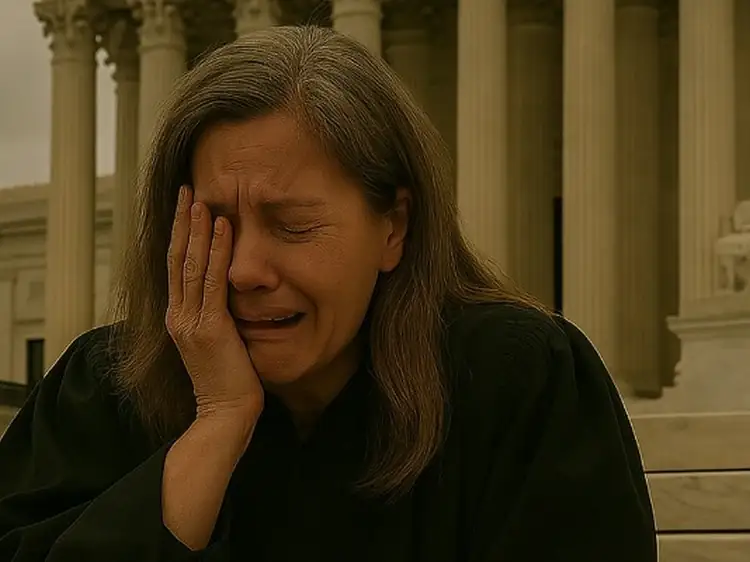
Later that day, with a heavy heart and shattered composure, she left the corridors of the Supreme Court. The polished marble steps that had once symbolized the pinnacle of justice now felt cold and unyielding beneath her weary footsteps. Finding a lonely landing, she sank onto the stairs, each step echoing her isolation. It was there, with the chill of stone against her skin and the weight of every lost moment pressing down upon her, that the tears began to fall—tears that were not merely for a position lost, but for an identity stripped away and a future suddenly rendered uncertain.
In a haunting twist of fate, as she sat grieving on those same cold stairs, she became a somber mirror to a recent farewell witnessed only days before. While one determined woman had stepped off these steps, embracing a new beginning with a heart full of hope, she, in the depths of her despair, dreaded that final goodbye. Her tears were not just a personal reckoning; they were a desperate plea for the mercy of time, a longing for redemption as history watched her fall.
In the cool embrace of twilight, the president stood alone outside the window of the Oval Office. Moments earlier, with deliberate precision, he had signed a document that he believed had cleansed a dark blot from his long, storied tenure. The contract of fate was sealed with his ink—final, irrevocable, and laden with the promise of redemption to his own eyes.
As the fading light danced over the stately facade behind him, an unsettling satisfaction warmed his heart. "I gave her everything, and now I have taken everything from her," he mused, each word resonating with a calculated glee. It was a cold, deliberate acknowledgment of the power he wielded—a power that had transformed the delicate balance of justice into a tool for personal vindication.
In that solitary, reflective moment, the president allowed his mind to wander through the corridors of his own life. He recalled both his greatest triumphs and his most regrettable missteps, all converging to this decisive act. The weight of history, so often a burden, now seemed to bolster his spirit. There, beneath the vast, indifferent sky, he found an echo of divine approval in his actions. With a measured, self-assured smile, he concluded that God, in this rare and singular moment, did love him—a testament, in his eyes, to the inevitable triumph of his vision and the sanctity of his chosen path.
Standing there in the quiet darkness, the president was more than a man in power; he was the architect of his own legacy, convinced that every loss and every gain had led him to this final, fateful reckoning.